Table of Contents:
- Telecommunication Meaning
- Business Applications of Telecommunication
- Business value of Telecommunication
- Trends in Telecommunications
- Applications of Internet
- Telecommunication Network Model
- Types of Telecommunication Network
- Telecommunication Alternatives
- Alternatives of Telecommunication Network Topologies
Telecommunication Meaning
Tele is a Greek word; its meaning is far. So the meaning of business is becoming internetworked enterprises. So we need telecommunication, which is “the communication over a distance”. Nowadays, telecommunication networks enable end users, teams, and workgroups to exchange information and data with other end users, customers, and business partners who are anywhere in the world. That’s why we need to study the interconnected computer network; it is very difficult for business applications, technology, and the impact of telecommunications on business organizations to survive.
Business Applications of Telecommunication
Telecommunication is very important for any kind of business. Through telecommunication, we can send any information in any form from one place to another. To send information from one place to another, we use electronic or light-emitting media. We can share information between individuals, called local communication, which usually occurs face to face, and remote communication takes place over distance, called telecommunication. Telecommunication includes telegraphy, television, and telephony. Telecommunication is used as a synonym for data communication activities.
We can divide the applications of telecommunication into three categories:
1. Enterprise Collaboration: This application supports coordination, collaboration, and communication among the members of the workgroup and business team.
2. Electronic Commerce: This application supports services and information over the internet, the selling and buying of products and services.
3. Internal Business: This application support company’s business operations through the use of different computer networks.
Business value of Telecommunication
From the business value point of view, telecommunication provides better customer service by reducing delay in filling orders through the use of the internet and extranets to transmit customer orders from a traveling salesperson to a corporate data center for order processing, and improves cash flow by speeding up the billing of customers. It reduces expensive business trips by desktop video conferencing between a company and its business partners and allows customers, suppliers, and employees to collaborate, thus improving the quality of decisions reached.
It also provides fast, convenient service, locks in customers and suppliers by EDI of transaction data to and from suppliers and customers.
Trends in Telecommunications
According to the changing needs of telecommunication in this fast-paced world, we can divide the trend of telecommunication into three major parts:
(i) Technology Trends: As we know, in the fast-paced world, we need every time some new kinds of technology to interconnect local and global digital networks for voice, data, images, and video, with heavy use of high-speed fibre optic lines and satellite channels.
(ii) Industry Trends: Here, we need a larger number of vendors and carriers to run the business with the growth of the industry.
(iii) Application Trends: It is required towards the pervasive use of enterprise intranets and the internet and inter-organizational extranets to support e-commerce, enterprise collaboration, and online business operations.
Applications of Internet
There are many applications of internet. Some of them are:
(i) World Wide Web
WWW is the network of millions of computers. It is a very popular service on the internet. It provides the facilities to share information with others.
(ii) File Transfer Protocol
By the use of FTP, one can transfer files from one computer to another. By transferring the file, one can share the resource of another computer.
(iii) Telnet
It is a protocol by which you can log on to any computer on the Internet. It is an internet service that enables an internet host to become the terminal of a remote computer.
(iv) Web Browsers
It is a tool to browse cyberspace and is used to access pages of the World Wide Web. The most popular web browsers are MS explorer and, Netscape Navigator, and Mosaic.
(v) E-mail
It is an offline way of communication between different internet users. E-mail allows sending a message to a specific person or group of persons at the same time.
(vi) Usenet
It is a collection of more than 5,000 newsgroups or discussion groups. Anyone can contribute a message to a Usenet group. To access the usenet there is a program called newsreader through which we can read an entire thread, all the replies to an interesting article.
(vii) Newsgroup
It is an international bulletin board. Each group is a forum for a different subject, where we can post questions and answers. There are more than thousands of groups covering just about any area of interest. We can see all these groups by the use of Internet Explorer or Netscape Navigator. Anything that is posted to the newsgroup will be sent all over the world to every news server.
(viii) Internet Relay Chat
IRC is the place where you meet people from all over the world and can talk about any subject you want. It provides real-time communication with others on the net.
Telecommunication Network Model
Telecommunication unication network model is an arrangement where a sender transmits or sends a message to a receiver through a channel consisting of some type of medium. The telecommunication network model has five basic categories of components.
(i) Terminals: It is the networked personal computers or video terminals. It is an input/output device that receives and transmits data.
(ii) Telecommunication processors: It consists and support various functions in telecommunication. It also supports data transmission. Examples of telecommunication processors are routers, modems, and switches. They convert data from digital to analog and vice versa, and decode data and control the speed and accuracy of the communications.
(iii) Telecommunication channel: Through the telecommunication channel, the data can be received and transmitted. It is the combination of media and communication satellites. Examples of media are fibre optic cables, copper wires, microwave systems, etc.
(iv) Computer: A telecommunication network interconnects all sizes and types of computers in such a way that they will do their own work without intervention.
(v) Telecommunication control software: It manages the functions of telecommunication and controls the activities of telecommunication.
Types of Telecommunication Network
A network is a combination of computers. It is of many types, such as LAN, WAN, and interconnected networks.
Local Area Network (LAN)
It connects two or more computer with in a very small range, such as a room, building, office, or institute, etc. LAN connects the computer which are 1 m to 1 km apart from each other. LANs are connected by a router, a bridge, or a gateway. A bridge is used to connect two similar Local Area Networks (LANs). A gateway is used to connect two different LANs. A router is used to connect two or more similar LANs.
Characteristics of LAN
- It has a low cost
- Its spread over size is moderate
- It is based on resource sharing
- Every device can communicate with any other
- Independent devices are connected with a high degree.
Hardware Required for LAN
- Transmission channel
- Servers
- Workstations
- Network interface unit
Software Required for LAN
- Server software
- Workstation software
Applications of LAN
- Sharing database
- Administering software
- Sharing personal files
Wide Area Network (WAN)
Wide Area Networks (WANs) are telecommunication networks that are designed to cover wide geographical regions. The main objective of WAN is to provide efficient transmission among sites and the sharing of hardware and software economically and efficiently by different users.
These are two types of wide area network that are: public networks and private networks. WANs are generally connected through routers or satellites.
Characteristics of WAN
- Its cost is more than LAN.
- Its spread over size is much more than LAN.
- All topologies are used to connect the computers.
- The speed of communication is less than that of a LAN.
- It consists of several layers between the source and the destination.
Applications of WAN
- Used in the automotive network exchange.
- Public switched telephone network.
Interconnected Network
When two LANs are connected in a wide area network, the network produced is called an interconnected network.
Characteristics of Interconnected Network
- It enables end users to communicate with the workstations of colleagues on other LANs.
- It enables end users to access the computing resources and the database at other company locations.
- It create seamless network of internet-like networks.
Application of Interconnected Network
- It is used in the FMC corporation.
Client/Server Network
It is used to decrease the size of the computing systems of many organisations. In this network architecture, each computer or process on the network is either a client or a server. The server is having a superiority over other nodes, and the other nodes are called client which are served by the server. A server must be a powerful computer dedicated to managing disk drives, printers, or network traffic, whereas clients may be less powerful computers on which users can run application programs.
Clients interact with users, providing an interface to allow the user to request services of the server and to display results returned by the server.
Servers are passive in that they never initiate communications but instead wait for requests to arrive from clients and then respond to those requests.
The Advantage of Client Server Model
not tend to slow down with heavy use. Client/server model works with any size or topology of LAN and does not tend to slow down with heavy use.
Telecommunication Alternatives
In the fast-changing field of information technology, telecommunication is highly technical. Most of the end users do not want to know the details of its technical characteristic but the knowledge of some components is essential. There are five basic components of telecommunication. Each has many alternatives. We discuss here the alternative of each component of telecommunication one by one.
Alternatives of Telecommunication Media
There are many alternatives to telecommunication media. Some of them are given below:
(i) Twisted-pair wire
It is the most common type of telecommunication media. Its frequency range is suitable for both data and voice transmission. It consists of two conductors, each with its own coloured plastic insulation. The total effect of noise at the receiver is usually zero because by twisting, the commutative effect of the interference is equal on both the wires. Twisting does not always eliminate the impact of noise, but it reduces the noise significantly. They are used in home and office telephone systems, and many LANs and WANs.
(ii) Coaxial Cable
They carry signals of higher frequency ranges than twisted pair cable. It has a central core conductor of solid enclosed in an insulating sheath that in turn is enclosed in an outer conductor of metal foil. This outer conductor is also enclosed in a static cover of the cable, and the insulation minimizes the interference and distortion of the signals. It can be placed underground and laid on the floors of lakes and oceans. The speed of data transmission is faster in it. They are used in cable TV and for short-distance connections of computers.
(iii) Optical fibre
Fibre optic cables have a core surrounded by a cladding forming the fibre. The entire cable is enclosed in an outer jacket. Both the core and cladding are made of glass, but of different densities. Its speed is very high and have greater capacity. They are not affected by electromagnetic radiation and also do not generate electromagnetic radiation. Requirement of repeater for signal retransmission is minimal. It has a much lower data error rate and is harder to tap. Light source for the optical fibre can be either a Light Emitting Diode or an Injection Laser Diode. Some disadvantages of fibre cable include maintenance problems, the cost of installation, and fragility.
(iv) Microwave transmission
Sometimes we need to transmit signals over long distance then we need unguided media. Microwave high electromagnetic frequency is used to transmit signals over long distance like in space exploration, Antarctica expeditions, etc. It uses bandwidth, and data transmission rates are high. There are two types 2 to 40 gigahertz frequencies in the electromagnetic spectrum. Its of microwave data communication system: satellite systems and terrestrial (earth-based) systems.
Terrestrial microwave is used to connect separate locations where cabling would be either too expensive, too difficult to install, or prohibited.
A microwave signal has high speed, and the physical path is in the line of sight. Relay towers are used as a separator or to extend signals. If we use directional parabolic antennas to send and receive signals in the lower gigahertz range, these antennas are placed on top of buildings, hills, or towers. They are used for both MAN and long-distance.
Satellite communication is like line-of-sight microwave transmission in which one of the stations is a satellite orbiting the Earth. The satellite will be acting as a repeater and super tall antenna. Initially, they were used for voice and video transmission; now they are also used for high-speed transmission of large volumes of data. They transmit signals between line terrestrial microwave systems and directional parabolic antennas. They must be in the line of sight and use lower Giga Hertz. It provides global transmission capability, therefore enabling connectivity to and from any location on Earth. From the ground to the satellite, the transmission is uplink, which uses 14-14.5 GHz frequency, and from satellite to ground, the transmission is downlink, which uses 11.7-12.2 GHz frequency.
Alternatives of Telecommunication Processors
The different alternatives of telecommunication processors are modems, multiplexers, switches, routers, etc.
1. Modems
It is a very commonly used telecommunication processor. The main job of the modem is to convert digital signals from a terminal at one end of the communication link into analog frequencies that can be transmitted over ordinary phone lines. Another modem, which is at the other end convert the transmitted data back into digital form at the receiving terminal. Converting the digital form of data into analog form is called modulation, and converting the analog form into digital form is called demodulation.
The purpose of a modem is to modulate and demodulate a signal. The modem, which is the data communication equipment, is connected between the terminal/computer.
There are two physical types of modems: internal and external modems.
The external modem is placed next to the computer and connected to the serial port using a straight-through serial cable.
Internal modems are plug-in circuit boards that are placed inside the computer.
Internal modems are less expensive than external modems because they do not need a case, power supply, or serial cable.
Types of Modems
Some most common types of modems are:
(i) Optical Modems: It uses optical fibre cable and converts the digital signal to pulses of light to be transmitted over optical lines.
(ii) V.32 Modem: It uses a 2400-band modem with 4-bit encoding. Its transfer rate is 9600 bps.
(iii) Short Haul Modems: It is used to transmit over 20 miles or less. It is used at home or in different offices in the same building.
(iv) Smart Modem: It is with a CPU on board that uses the Hayes AT command set.
(v) Digital Modems: It converts the RS-232 digital signals to digital signals that are more suitable for transmission.
Features of Modems
(i) Speed: Modem speeds are 300, 600, 1200, 2400, 4800, 9600, 14.4 K, 19.2 Κ, 28.8 Κ, 56 Kbps.
(ii) Auto dial/redial: Smart modems can dial and redial the phone number if a busy signal is received.
(iii) Self-testing: New modems can test the digital connection to the terminal and the analog connection to a remote modem.
(iv) Auto answer: Most modems can have the capability of auto answering the phone when an incoming call comes in.
(v) Synchronous/asynchronous transmission: New modems have an option of transmission type, asynchronous/synchronous.
2. Multiplexers
It is a communication process that allows a single communications channel to carry simultaneous data transmissions from different terminals/computers. Analog and digital signals are multiplexed in different ways.
An analog signal uses frequency division multiplexing (FDM) to carry multiple conversations. FDM divides a high-speed channel into multiple slow-speed channels.
Digital signals are multiplexed over a link using time division multiplexing (TDM). It divides the time each terminal can use the high-speed line into multiple short time slots or time frames
3. Internetwork Processors
There are many communication processors. Some of them are
(i) Switch: It makes connections between telecommunication circuits in a network so that the message can reach its destination
(ii) Router: They are intelligent pieces of hardware that control the flow of data between networks. It enables you to isolate traffic on a separate network.
(iii) Hubs: They are boxes that enable multiple computers to connect to a single point.
(iv) Gateway: It solves the hard-to-reach problems that crop up when one type of network-traffic needs to cross over or interact with a different type of network.
Alternatives of Telecommunication Software
Different alternatives of telecommunication software are access control, error control, transmission control, network management, and security management. These are briefly discussed below:
(i) Access control software: It connects and disconnects communication links and checks the transmission mode, transmission speed, and transmission direction. It also involves automatic dialing and redialing of the phone and logging on and off with the account number.
(ii) Error control: It detects the error and then removes it, which is caused by distortions in the communication channel.
(iii) Transmission control: It sends and receives messages, programs, data, and commands.
(iv) Network management: It manages the communication in a telecommunication network.
(v) Security management: It protects a communication network from unauthorized access.
Alternatives of Telecommunication Network Topologies
Alternatives of telecommunication network topologies are star, ring, and bus. These are discussed below:
1. Star Network Topology: In a star network topology, there is one centralized computer. All communication first goes through the centralized computer, allowing it to control the operation, workload, and resource allocation of the other computers in the network.
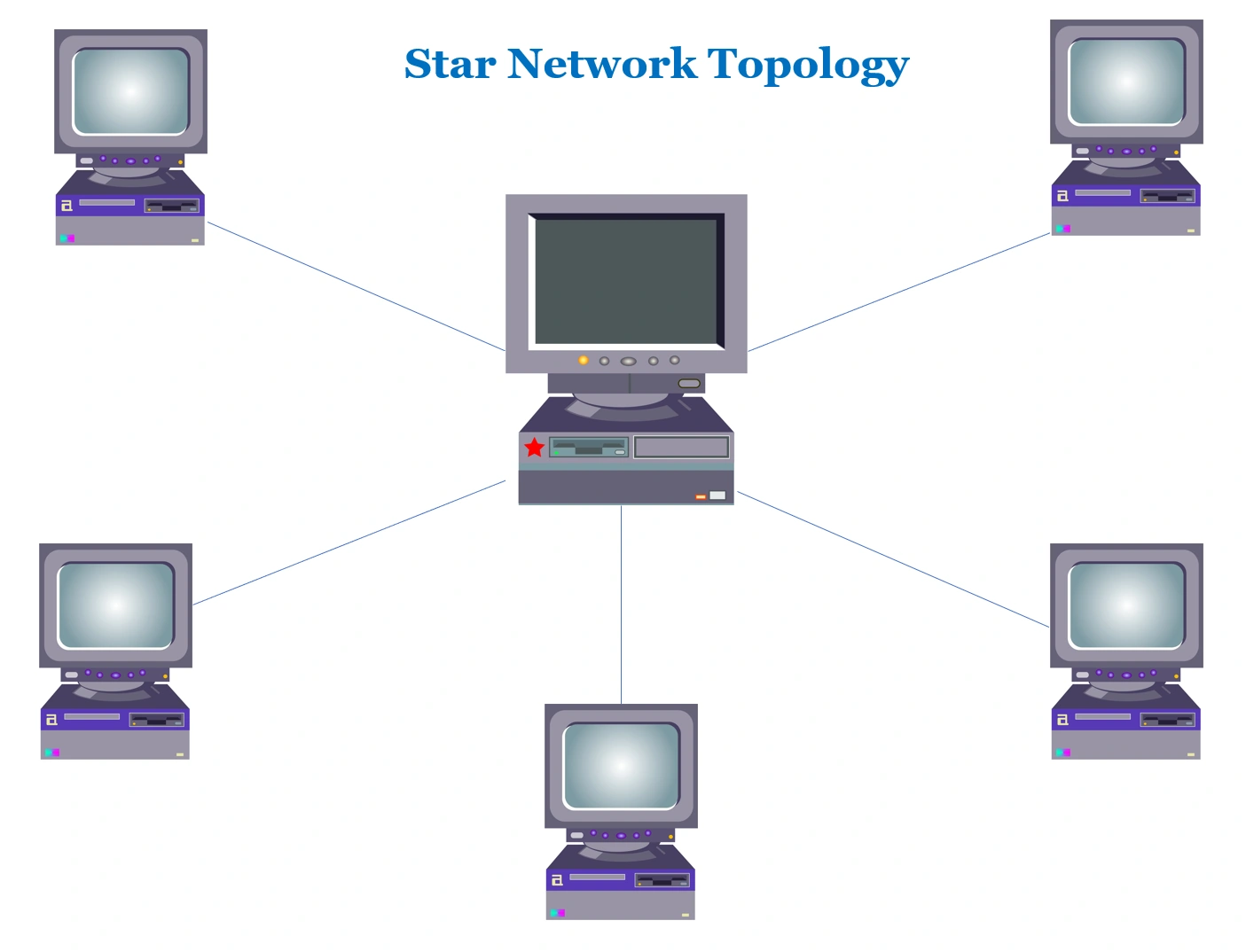 The advantage is that it is relatively simple, but the disadvantage is that if the central computer breaks down, none of the other computers can communicate with each other.
2. Ring Network Topology: In this network topology, there is no centralized computer as in a star network; instead, the computers are connected in a ring form. A ring may be unidirectional or bidirectional.
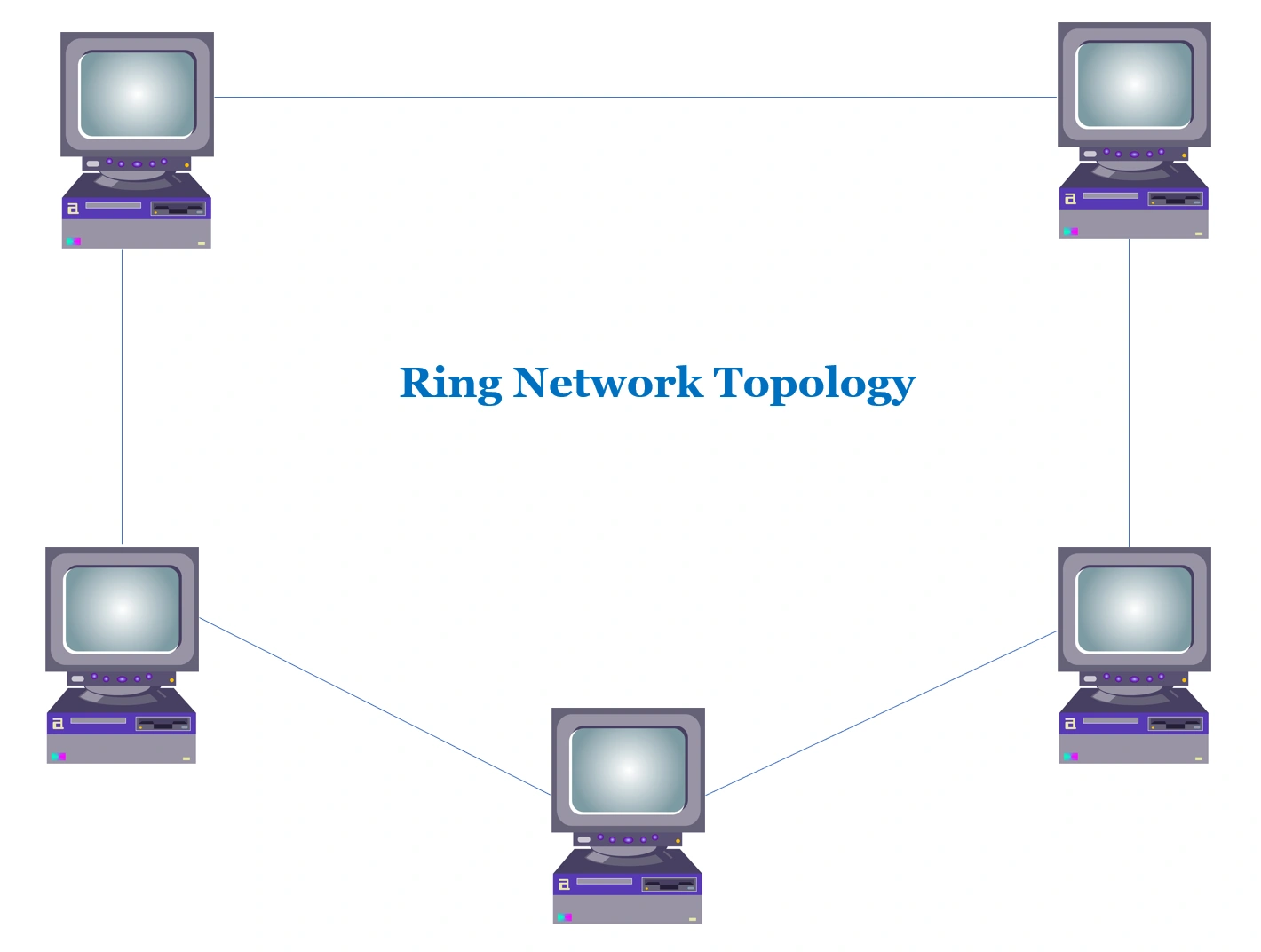
In unidirectional data can move only in one direction, whereas in bi-directional data can move in both directions (clockwise or anticlockwise)
3. Bus Network Topology: Each node in this network is connected to a single communication cable via an interface. In a bus network, any computer can communicate directly with every other computer or device. Each node has an address:
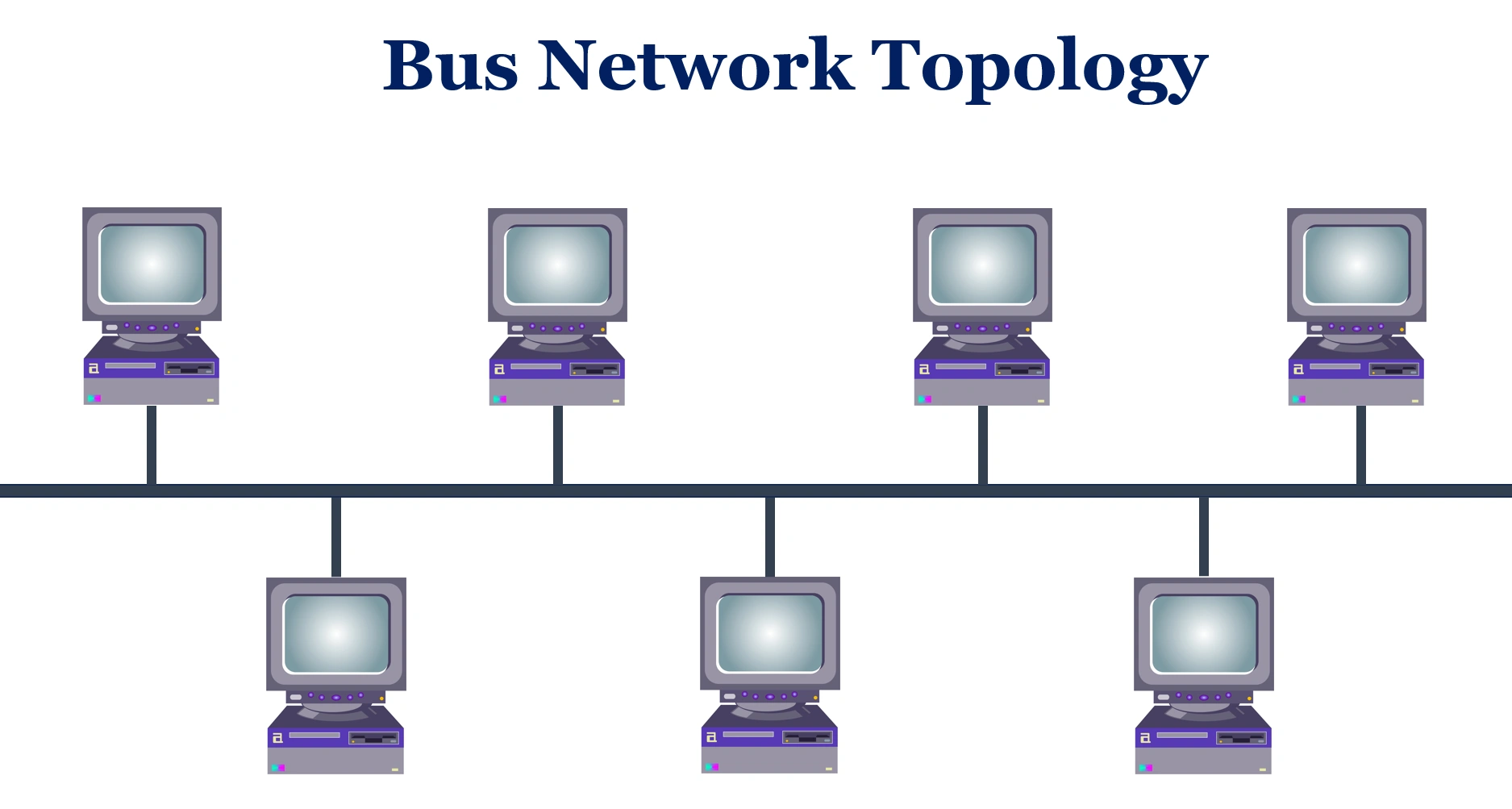
It is frequently used in LANs. Going through a hierarchy of mod is not necessary. A bus is used as a carrier for data packets. The computer communicates by sending various packets, and each packet contains the destination address. Packets are traversed along the bus, and all the computers on the network have access to the bus.
Alternatives of Bandwidth
Communication speed and capacity of telecommunication networks can be divided into groups according to the range of bandwidth. Communication speed and the capacity of data transmission rate are measured in bits per second. It is also known as the band rate.
(i) Voiceband: It is also known as low-speed analog channels. They are used for transmission rates from 300 to 9,600 bps. They are unshielded twisted pair lines used for voice communication and data communication.
(ii) Medium band: They are used for transmission rates from 9,600 bps up to 100 Mbps. They are also known as medium speed channel. They are shielded twisted pair lines.
(iii) Broadband: It is also known as high speed digital channel. It allows transmission rates at specific intervals from 256,000 bps to several billion bps. They use fibre optics or satellite transmission.
Alternatives of Switching
Alternatives to switching are described below :
(i) Circuit switching: A circuit-switched network transmits a message by providing a complete path of transmission links from the sender node to the receiver node. This path is set up by a special signalling message sent by the sender node to the receiver node. The data is transmitted without any intermediate store and forward delays.
(ii) Message switching: A message-switched network transmits a message among the nodes by moving the message through various links and message buffers. Messages are stored in each node and then forwarded to the next node on their route. There is a possibility of message congestion and queuing in the nodes.
(iii) Packet switching: In packet switched network, long messages are first decomposed into fixed-size segments called packets, and then each packet takes a different route until it reaches the destination node.
(iv) Virtual circuit packet switching: A virtual circuit packet network uses a dedicated path for the transmission of packets and is fast enough for interactive communication. In this, switching packets are stored and forwarded from node to node, and no path is established initially.
Alternatives of Access Method
There are many methods to access the information. Some of them are:
(i) Polling: It is a communications processor that conducts a roll call of the terminals in a network to determine if they have a message to send.
(ii) Contention: In this, the terminals send the messages on the network on a first come first serve (FCFS) basis.
(iii) Token Passing: In this, the terminals use a token to send messages that are passed onto the appropriate terminal in the network.